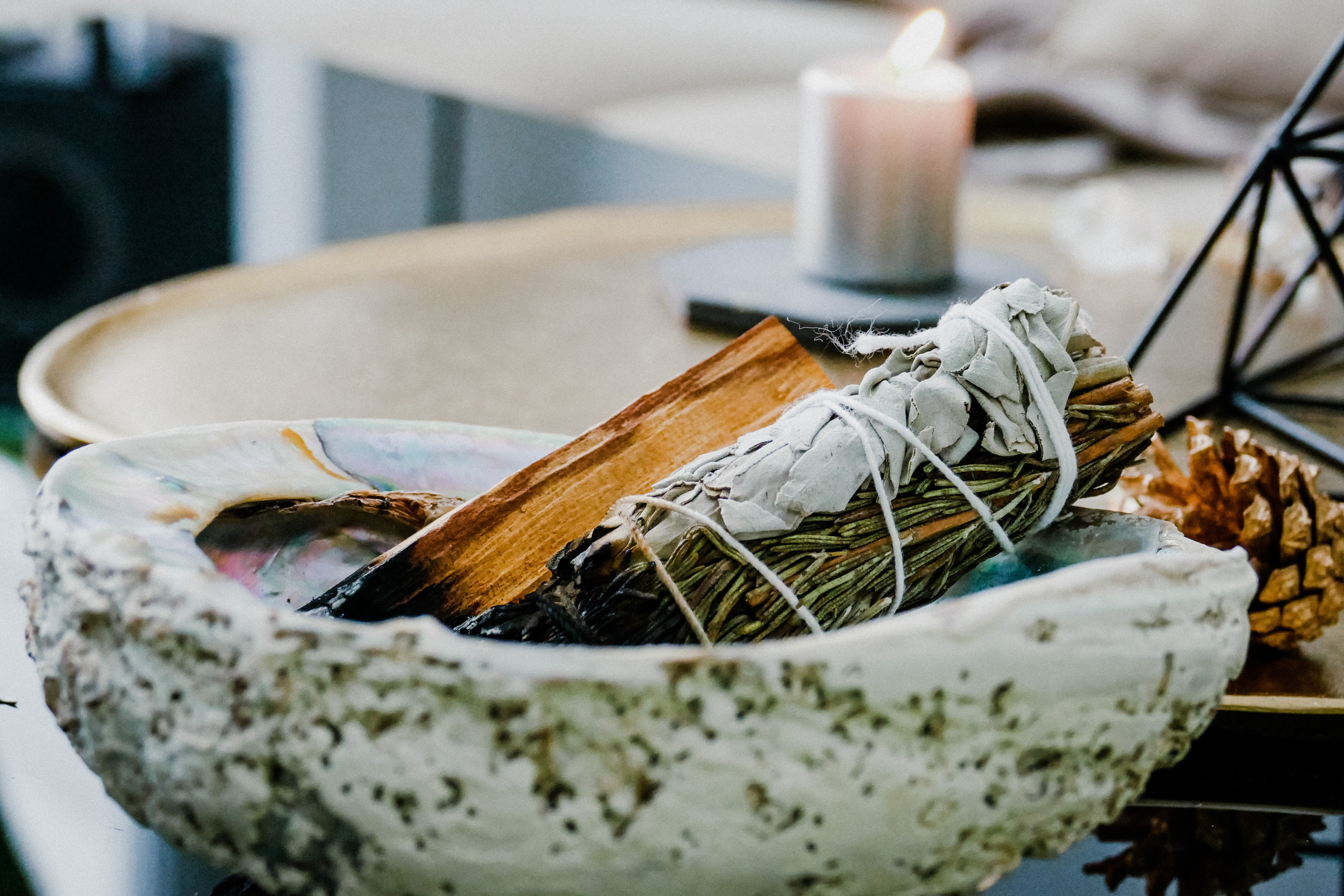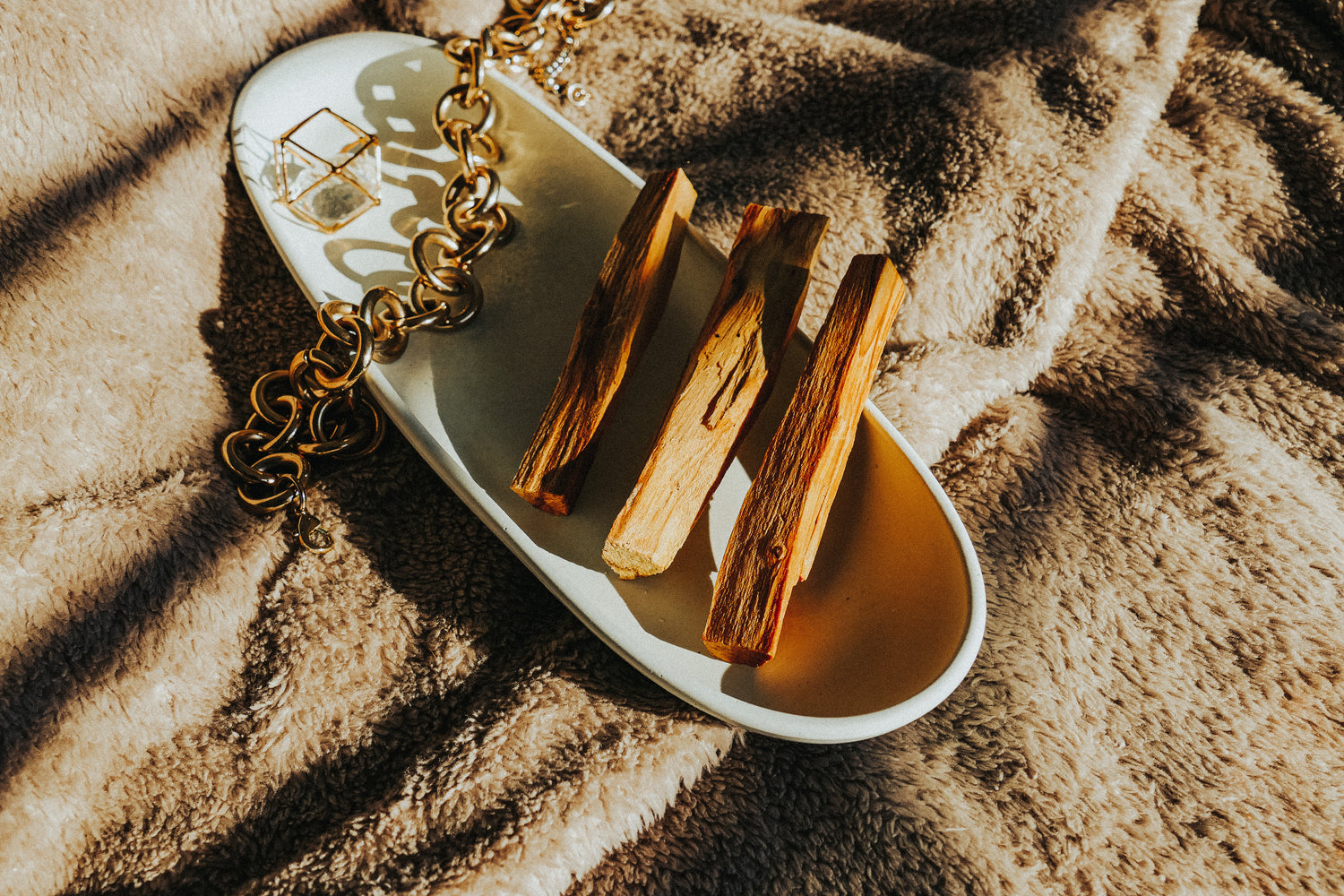
I will never forget the moment I encountered Palo Santo for the first time. After an exhausting day of work, I switched off my brain by scrolling through Instagram stories. As usual, I could hardly wait to see the posts from a local artist in Spain whose content was always inspiring and calming.
A few hours before I found myself drifting onto Instagram, she had posted a short video of her summer evening spent outside, in front of her house, accompanied by the gentle song of cicadas. On a rustic table lay a notebook filled with her thoughts and a clay dish from which something was gently smouldering.
The magic of that moment captivated me so completely that I decided to write to her and ask about the ritual, about that quietly smoking stick.
"That's Palo Santo," she replied. "I use it for calming down and encouraging creativity."
If only I had known what kind of journey that moment of curiosity would set in motion the very next day…

The Ancient Power and Use of Palo Santo
Palo Santo. This is the name we know for the wood of the Bursera graveolens tree, native to South America.
Today, the wood of this remarkable tree is used during meditation, relaxation rituals, and for inviting positive energy. When a Palo Santo stick is lit and then extinguished, the wood begins to smoulder and release its distinctive, enchanting scent — one that is difficult to put into words. Many say it smells of delicate lemon blended with baked apple. For others, the scent calls to mind burnt, caramelised sugar. What is universally true, however, is that it is hard to find a person who doesn't warm to the scent of Palo Santo.
Despite Palo Santo only becoming widely popular in the last few years, the story of this natural incense began in the time of the Incas. Even then, the people of the region recognised the magical power of Palo Santo — using it in spiritual ceremonies as well as for its wellbeing properties.
During the Inca era, aromatic oil was also extracted from Palo Santo and used for relaxation — applied to the nape of the neck or along the spine — as well as for energetically cleansing those upon whom it was placed.
This sacred wood, as it is known all over the world, is still used by shamans in Peru to this day. They light a stick, carry the smoke around those who have come seeking support, and in doing so cleanse the person's energetic space, removing misfortune, negative thought patterns, and unwanted energies.

In South America, Palo Santo is also used in the form of a tea or water infusion, particularly in Ayahuasca rituals. Shamans soak Palo Santo wood in water and offer this infusion as a drink to all who will take part in the ritual, as it is believed that before the ceremony the body and mind must be cleared of negative energy.
Incense became popular very quickly in Ecuador as well. There, the tradition of burning Palo Santo is still practised today, as people believe the smoke drives away negative energy — or "mala energía".
One of the Ecuadorian proverbs even speaks of this remarkable power of Palo Santo:
"Palo santo para limpiar tu casa de la mala energia, palo santo para la buena suerte."
or translated:
"Palo Santo, to cleanse your home of negative energy, Palo Santo for good fortune."
How Is Palo Santo Made?
Bursera graveolens is a wild tree native to the regions of Peru and Venezuela. It grows in dry, tropical areas across Mexico, Peru, Guatemala, Ecuador, and many other regions.
Yet the journey of Palo Santo from tree to a stick you can light at home is not a simple one.
For the wood to develop its distinctive aroma, the tree must grow to maturity and die naturally — a process that can take between 50 and 70 years. If the tree is cut down, it will not develop those characteristic scents with the same depth and richness for which this wood is otherwise known.
And even when the tree has died naturally and fallen, it cannot simply be gathered, cut, and sent out into the world. The tree must lie on the ground for at least five to eight years. This is how long it takes for the essential oils inside the wood to properly mature — and without this process of ripening, the wood cannot become the quality incense we know today.

The Issue of Harvesting Palo Santo
Palo Santo — the Bursera graveolens tree — is not an endangered species. Since 2010 it has been placed on the list of "stable" species, though this does not mean the tree can be treated irresponsibly.
Demand for Palo Santo is ever-growing, and this has given rise to two problems:
- Some people continue to illegally fell trees and sell the wood on the market,
- Synthetic versions of Palo Santo wood have appeared on the market, lining the pockets of corporations while leaving customers deeply disappointed.
Because of this, it is important that as end users we seek out trustworthy suppliers who sell authentic wood that has been sustainably grown and harvested. Only by purchasing such wood will we receive a quality product, while also ensuring we do not inadvertently support irresponsible sellers who treat Nature carelessly.
How to Recognise Authentic Palo Santo Wood
Due to the enormous interest in Palo Santo, many sellers have turned to selling synthetic versions of Palo Santo sticks, or to cutting corners at the expense of their customers.
One such shortcut involves soaking ordinary wood in various chemicals to create a scent that resembles authentic Palo Santo. These versions are considerably less aromatic — and far more hazardous, as burning the wood releases the artificial chemicals into the air.
So how do we tell a synthetic or artificial Palo Santo from the real thing?
Genuine Palo Santo wood has a beautiful, pleasant, and intense scent that is hard to describe. Artificial or counterfeit Palo Santo, by contrast, has a noticeably weaker fragrance that lacks that warmth and pleasantness — it tends to smell more like burnt wood.
Authentic Palo Santo wood will produce white smoke once the flame on the stick has been extinguished. If you are burning a fake stick, the smoke will remain dark even after the flame has gone out.

The Wellbeing Properties of Palo Santo
Now that you know what to look out for when buying Palo Santo wood, it is time to talk about its wellbeing properties.
The distinctive scent of Palo Santo comes from a special compound called Limonene, which is found in abundance in the tree's essential oil. Limonene is known for its many beneficial effects on the body and mind. This essential oil is antibacterial, anti-inflammatory, and antiseptic. It is precisely these qualities that keep it extraordinarily popular among practitioners around the world.
Limonene is also widely valued for its role in supporting calm in times of stress, which is why Palo Santo remains at the very heart of natural ingredients for relaxation. People use it regularly during meditation, yoga, or as part of an everyday unwinding practice.

Beyond all its other qualities, Palo Santo is also well known for repelling mosquitoes and other insects — which is why many people reach for it during the summer months, when we begin spending our evenings outside in good company. Not only will it bring good energy to the heart of your gathering, it will also keep the mosquitoes at bay.
The long history of Palo Santo also speaks to other metaphysical qualities of this beautiful gift from Nature. With regular use, the wood:
- Enhances our creativity,
- Invites positive energy,
- Clears negative energy from our surroundings,
- Supports our concentration,
- Strengthens the connection with our true self.
The Magic of Palo Santo
Not long after I first discovered Palo Santo through that artist in Spain, I ordered my own stick.
I won't forget the feeling of impatience as I waited for my parcel to arrive — alongside a faint touch of scepticism. Could Palo Santo really be as wonderful as everyone said?
When the day finally came and the parcel arrived, I shut myself in my office, lit a candle, and slowly held the Palo Santo over the flame. An intoxicating scent began to fill the room. I could barely believe that Nature could create something so beautiful, something so extraordinary.
From that moment on, my moments of unwinding were never quite the same. Since then, Palo Santo has always been by my side — and that is something that will never change.
It is time for you to discover the magic of this wood for yourselves.
![[POSLUŠAJ] Feel Good Vibes](http://www.yoursoultime.si/cdn/shop/articles/Copy_of_VEGAS_IS_WAITING_....png?v=1615219709&width=1200)